Desaraju Surya
Hyderabad: History is repeating in Andhra Pradesh vis-à-vis the Micro-Finance Institutions (MFIs). The spectre of MFIs has come to haunt the hapless poor borrowers, particularly in the rural areas, as both the state government as well as the Centre did practically nothing in the last four years after the ghost first raised its ugly head in 2006. More than 70 persons committed suicide unable to bear the “torture” unleashed by unscrupulous MFIs in AP in 2006 while in just over a month now more than 40 people met with a similar tragic end. Official “toll” this year, however, is just 23. Be it pushing women into flesh trade, forcing them to stand in blazing sun (as punishment) for hours, humiliating them in front of other villagers or seizing ration cards and Aarogyasri health insurance cards for non-repayment of loans in time… the so-called “recovery agents” of MFIs resort to every inhuman method to intimidate the poor borrowers. “Those who could not stand this are committing suicide,” a district Collector pointed out. Same things happened in 2006 when the scale of operations of MFIs in the state was between Rs 1000 crore and Rs 1500 crore. Now, of the total Rs 30,000 crore MFIs’ outstanding in the country, Andhra Pradesh accounts for about 40 per cent. The defaults were estimated to be between one and 1.5 per cent, government sources said. It was the then Y S Rajasekhara Reddy’s government that vigorously encouraged the MFIs in the state as a means “to deliver rural credit at cheaper rates” and eventually “make every woman a lakhpathi (millionaire).” In October 2005, AICC general secretary Rahul Gandhi toured Islampur in Medak district and Medchal allegedly to promote Share Microfin. A couple of years later, Rahul visited Bhongir in Nalgonda district on behalf of SKS Microfinance, promoted by Vikram Akula.
“Rahul has close links with MFIs. As a fellow MP, I am ready for a debate with him on this,” Telugu Desam Parliamentary Party leader Nama Nageswara Rao challenged even as Chief Minister K Rosaiah shot back saying the Amethi MP has “no love” for the MFIs. At the height of the MFI crisis in 2006, Rajasekhara Reddy promised to bring in legislation putting a cap on the interest rate charged by MFIs but failed. The ball was then pushed into the Centre’s court without any effect. Also, the state government did not even act on the report of the one-man committee it appointed to probe into the excesses of MFIs. The then Special Chief Secretary to government V P Jauhari, who headed the committee, had recommended strong measures to rein in the MFIs essentially to arrest an “emerging mafia” and also protect poor borrowers from its clutches. He had cautioned that there was a possibility of “other criminal elements” entering the fray since “easy money” was involved. Going by the events unfolding over the past one month, Jauhari’s fears appear to have come true. Four years have elapsed and on July 20 this year, Union Finance Minister Pranab Mukherjee announced in Hyderabad that the Central government would soon arrive at a decision on the Bill to regulate micro finance institutions. “The Bill is under examination of the government and we shall soon arrive at a decision,” he said, when questioned about the long-pending legislation that primarily is intended to place a cap on the interest rates being charged by MFIs. Still, nothing happened on the legislation front but MFIs were back to their nefarious ways. Now, the Centre appears to be in no mood to place a cap on the interest rate charged by MFIs nor put in place an effective mechanism to strictly regulate the errant money-lending firms. The Union Finance Minister's assertions on MFIs make this clear.
Since the start of this month, one after the other poor borrowers in rural parts of AP started ending their lives unable to repay the loans on which usurious rates of interest were charged. Left with no other option, the state government hurriedly promulgated an ordinance making it mandatory for MFIs to register their activities with the respective District Rural Development Agency. But it could not place a cap on the interest rate since the subject was under the Centre’s domain, a senior official of the Rural Development Department said. In fact, state Rural Development Minister Vatti Vasantha Kumar sounded the warning bell at a meeting of the State-Level Bankers’ Committee on September 28 saying: “The exorbitant rate of interest being charged by MFIs ranging from 36 to 48 per cent is not at all an encouraging trend.” His alarm stemmed from the fact that banks lent only about Rs 1,900 crore to women self-help groups (SHGs) as against the ambitious target of Rs 11,775 crore set for the 2010-11 financial year. “Bankers are not at all positive on social-sector lending. As long as banks are not able to achieve total financial inclusion, alternative source of credit is required and thus MFIs have become a necessary evil,” a district Collector observed. How the Centre and the state governments handle this evil is anxiously watched even as reports of suicides by harassed small loan borrowers continue to come in from different parts of the state.
Thursday, 28 October 2010
Chiru trimming up for his 150th venture
Desaraju Surya
Hyderabad: With his next feature film set to be launched in January 2011, actor-turned-politician Chiranjeevi is now busy losing weight, the extra kilos he has put on over the last four years since his last film Shankar Dada Zindabad (remake of Lagey Raho Munna Bhai). Chiranjeevi visited the US recently reportedly for a liposuction treatment as part of the weight reduction programme. Fatty foods are now off his menu and Chiranjeevi is mostly taking nutritional drinks these days to keep himself "fit" for his 150th silver screen venture, one of his aides said. The audience at an audio release function here the other day was pleasantly surprised to see a "trim" Chiru, as he is fondly called, clad in a sleek jeans trouser and white shirt. The Telugu Megastar quit films after a 30-year career in August 2008 and launched the Praja Rajyam Party. He, however, made it clear while launching the political outfit that he might don the grease paint again to feature in films that carried a social message. On his son and upcoming actor Ramcharan Tej's prodding, Chiru made a guest appearance in Magadheera starring Tej last year, that went on to become a blockbuster. Now, Charan himself will be producing a full-length feature film with his father. Though the film is expected to go to the sets in January, Chiranjeevi is still scouting for the right script that befits his new stature as a politician. Apart from the script, the increasing flab in his body has been a major concern for 56-year-old Chiranjeevi, who was left with the only option of cutting it. "One can't imagine a Chiranjeevi film without his trendy dances and stylish stunts. Obviously his body should be in the right shape for that and hence he is consciously doing everything in that direction," a key aide of the actor said. Following a weight-reduction regimen is not new to Chiranjeevi. Even during the late part of his career in the late 1990s when he was doing one film after the other, Chiru had to cut his flab. "It happened when Chiru did films like Mrugaraju and Daddy though he once again looked stout in movies like Stalin and Shankar Dada Zindabad. Now again he is keen on regaining the old charming looks," the aide pointed out. Praja Rajyam sources say Chiranjeevi has stopped eating even biscuits at the party meetings and has been taking only liquid diet specially brought from home. With a younger lot of stars with six-pack bodies and lanky physiques ruling the tinsel town, Chiranjeevi certainly has a task on hand in his silver-screen re-coming.
Hyderabad: With his next feature film set to be launched in January 2011, actor-turned-politician Chiranjeevi is now busy losing weight, the extra kilos he has put on over the last four years since his last film Shankar Dada Zindabad (remake of Lagey Raho Munna Bhai). Chiranjeevi visited the US recently reportedly for a liposuction treatment as part of the weight reduction programme. Fatty foods are now off his menu and Chiranjeevi is mostly taking nutritional drinks these days to keep himself "fit" for his 150th silver screen venture, one of his aides said. The audience at an audio release function here the other day was pleasantly surprised to see a "trim" Chiru, as he is fondly called, clad in a sleek jeans trouser and white shirt. The Telugu Megastar quit films after a 30-year career in August 2008 and launched the Praja Rajyam Party. He, however, made it clear while launching the political outfit that he might don the grease paint again to feature in films that carried a social message. On his son and upcoming actor Ramcharan Tej's prodding, Chiru made a guest appearance in Magadheera starring Tej last year, that went on to become a blockbuster. Now, Charan himself will be producing a full-length feature film with his father. Though the film is expected to go to the sets in January, Chiranjeevi is still scouting for the right script that befits his new stature as a politician. Apart from the script, the increasing flab in his body has been a major concern for 56-year-old Chiranjeevi, who was left with the only option of cutting it. "One can't imagine a Chiranjeevi film without his trendy dances and stylish stunts. Obviously his body should be in the right shape for that and hence he is consciously doing everything in that direction," a key aide of the actor said. Following a weight-reduction regimen is not new to Chiranjeevi. Even during the late part of his career in the late 1990s when he was doing one film after the other, Chiru had to cut his flab. "It happened when Chiru did films like Mrugaraju and Daddy though he once again looked stout in movies like Stalin and Shankar Dada Zindabad. Now again he is keen on regaining the old charming looks," the aide pointed out. Praja Rajyam sources say Chiranjeevi has stopped eating even biscuits at the party meetings and has been taking only liquid diet specially brought from home. With a younger lot of stars with six-pack bodies and lanky physiques ruling the tinsel town, Chiranjeevi certainly has a task on hand in his silver-screen re-coming.
Friday, 24 September 2010
JALAYAGNAM: The scene so far
Desaraju Surya
Hyderabad: By any count, the most ambitious and equally controversial “Jalayagnam” programme undertaken by the Andhra Pradesh government has been a disaster so far.
Controversies, legal battles, environmental concerns, adverse observations by the Comptroller and Auditor General over large-scale financial misappropriation, lack of statutory clearances, inter-state disputes, natural calamities and, above all, a grave financial crunch have contributed to the grandiose programme going way off the track over the last six years.
When initially conceived in 2004 by the then Y S Rajasekhara Reddy government, the Jalayagnam – dubbed by the rulers as a “massive water conservation ritual” – was meant to provide water for irrigation to an additional 82 lakh acres of agricultural land in Andhra, Rayalaseema and Telangana regions of the state through 32 major and 17 medium projects in five years (by 2009). The initial cost estimates for these projects were Rs 65,000 crore.
Six years after the programme was launched, the government had already spent Rs 53,206 crore but could irrigate only an additional 26.25 lakh acres as per the latest count. By now the number of projects under the programme has gone up to 88, including 44 major and 30 medium, to irrigate an additional one crore acres while the cost too escalated to a staggering Rs 1,79,679 crore. Of the total, 39 have been identified as “priority” projects that will be completed in the first go.
The revised deadline for completion of the Jalayagnam programme is year 2014 – when general elections are due in the state – but, by all means, even that deadline will be missed, Irrigation Department officials admit.
All the works have come to a virtual standstill as the state government owes over Rs 6,000 crore to the contractors executing the projects. Given the severe financial crisis, the government is finding it difficult to clear the dues and let the works progress, the officials say. “We have cleared dues amounting to over Rs 1,500 crore so far and will be clearing the balance in a phased manner,” a top official of the Department said.
“We have completed 12 irrigation projects in the last six years, including four major, under Jalayagnam. These projects created a capacity to impound an additional 295 tmc ft of water which in turn contributes to an additional agricultural production worth Rs 8,850 crore per annum in the state,” Major Irrigation Minister Ponnala Lakshmaiah claimed.
Chief Minister K Rosaiah or Lakshmaiah never lose an opportunity to proclaim that Jalayagnam continues to be the government’s “flagship” programme and will be completed at all costs.
There is a rider, of course: the Government of India should be magnanimous to accord “national status” to at least three major projects so that the state can get 90 per cent of funds as grant.
Take the case of the multi-purpose Polavaram irrigation project on river Godavari.
For the last six years, the state government has been desperately seeking national status for Polavaram even as the project cost has shot up from Rs 10,151 crore in 2009 to Rs 17,600 crore as per the latest estimates. But there has so far been no word from the Centre on granting national status to the project while neighbouring Orissa is strongly fighting against it claiming that the project would lead to submergence of many villages on its side.
AP and Orissa are now locked in a legal battle in the Supreme Court over Polavaram.
Another major controversial project, the Pranahita-Chevella Lift Irrigation Scheme, has not got any statutory clearance from the Centre even two years after it was launched with a lot of fanfare. The project cost too shot up from Rs 33,500 crore to over Rs 40,000 crore now, official sources say. AP is not in a position to complete this project on its own and is looking desperately towards the Centre for according “national status” and bearing 90 per cent of the cost.
This project alone needs 3466 MW of power to lift water from Pranahita, a tributary of river Godavari, to a height of 1343 meters, resulting in an annual recurring expenditure of over Rs 2,300 crore.
“It is utterly foolish to take up such a project involving huge recurring expenditure. Can the government assure that it is ready to bear the annual expenditure,” questioned Lok Satta Party president and MLA N Jayaprakash Narayan.
But, the government has simply brushed aside his contention and asserted that it would go ahead with the project “for the betterment of Telangana.”
Pranahita-Chevella was mired in another controversy when it came to light that an astounding Rs 1,100 crore was paid to a private consultant for preparation of the detailed project report of which Rs 600 crore was already paid. The Public Accounts Committee of the state Legislature saw red over this and forced the irrigation department authorities to stop further payments.
Alarm bells, however, started ringing in the state government when Union Water Resources Minister Pavan Kumar Bansal stated that only one intra-state project would be funded under the category of national project. Chief Minister Rosaiah immediately wrote a letter to Bansal recalling that the Pranahita-Chevella project was among the 25 medium and major irrigation projects included in the Prime Minister’s package and was thus eligible for financial support under the Accelerated Irrigation Benefits Programme.
Still, there has been no response from the Centre on this, official sources in the Chief Minister’s Office said.
Another major project that has overshot several deadlines is Pulichintala on river Krishna. Meant to stabilize an ayacut of 13.5 lakh acres in five districts in Krishna’s command area, this project was supposed to be ready in 2007 but not even 60 per cent of the works have been completed yet, official sources admit. “The coffer dam of the project got washed away in floods at least three times leading to inordinate delay in completion of Pulichintala,” they say.
Such examples are one too many in the Jalayagnam story. And, it has no end in sight.
Hyderabad: By any count, the most ambitious and equally controversial “Jalayagnam” programme undertaken by the Andhra Pradesh government has been a disaster so far.
Controversies, legal battles, environmental concerns, adverse observations by the Comptroller and Auditor General over large-scale financial misappropriation, lack of statutory clearances, inter-state disputes, natural calamities and, above all, a grave financial crunch have contributed to the grandiose programme going way off the track over the last six years.
When initially conceived in 2004 by the then Y S Rajasekhara Reddy government, the Jalayagnam – dubbed by the rulers as a “massive water conservation ritual” – was meant to provide water for irrigation to an additional 82 lakh acres of agricultural land in Andhra, Rayalaseema and Telangana regions of the state through 32 major and 17 medium projects in five years (by 2009). The initial cost estimates for these projects were Rs 65,000 crore.
Six years after the programme was launched, the government had already spent Rs 53,206 crore but could irrigate only an additional 26.25 lakh acres as per the latest count. By now the number of projects under the programme has gone up to 88, including 44 major and 30 medium, to irrigate an additional one crore acres while the cost too escalated to a staggering Rs 1,79,679 crore. Of the total, 39 have been identified as “priority” projects that will be completed in the first go.
The revised deadline for completion of the Jalayagnam programme is year 2014 – when general elections are due in the state – but, by all means, even that deadline will be missed, Irrigation Department officials admit.
All the works have come to a virtual standstill as the state government owes over Rs 6,000 crore to the contractors executing the projects. Given the severe financial crisis, the government is finding it difficult to clear the dues and let the works progress, the officials say. “We have cleared dues amounting to over Rs 1,500 crore so far and will be clearing the balance in a phased manner,” a top official of the Department said.
“We have completed 12 irrigation projects in the last six years, including four major, under Jalayagnam. These projects created a capacity to impound an additional 295 tmc ft of water which in turn contributes to an additional agricultural production worth Rs 8,850 crore per annum in the state,” Major Irrigation Minister Ponnala Lakshmaiah claimed.
Chief Minister K Rosaiah or Lakshmaiah never lose an opportunity to proclaim that Jalayagnam continues to be the government’s “flagship” programme and will be completed at all costs.
There is a rider, of course: the Government of India should be magnanimous to accord “national status” to at least three major projects so that the state can get 90 per cent of funds as grant.
Take the case of the multi-purpose Polavaram irrigation project on river Godavari.
For the last six years, the state government has been desperately seeking national status for Polavaram even as the project cost has shot up from Rs 10,151 crore in 2009 to Rs 17,600 crore as per the latest estimates. But there has so far been no word from the Centre on granting national status to the project while neighbouring Orissa is strongly fighting against it claiming that the project would lead to submergence of many villages on its side.
AP and Orissa are now locked in a legal battle in the Supreme Court over Polavaram.
Another major controversial project, the Pranahita-Chevella Lift Irrigation Scheme, has not got any statutory clearance from the Centre even two years after it was launched with a lot of fanfare. The project cost too shot up from Rs 33,500 crore to over Rs 40,000 crore now, official sources say. AP is not in a position to complete this project on its own and is looking desperately towards the Centre for according “national status” and bearing 90 per cent of the cost.
This project alone needs 3466 MW of power to lift water from Pranahita, a tributary of river Godavari, to a height of 1343 meters, resulting in an annual recurring expenditure of over Rs 2,300 crore.
“It is utterly foolish to take up such a project involving huge recurring expenditure. Can the government assure that it is ready to bear the annual expenditure,” questioned Lok Satta Party president and MLA N Jayaprakash Narayan.
But, the government has simply brushed aside his contention and asserted that it would go ahead with the project “for the betterment of Telangana.”
Pranahita-Chevella was mired in another controversy when it came to light that an astounding Rs 1,100 crore was paid to a private consultant for preparation of the detailed project report of which Rs 600 crore was already paid. The Public Accounts Committee of the state Legislature saw red over this and forced the irrigation department authorities to stop further payments.
Alarm bells, however, started ringing in the state government when Union Water Resources Minister Pavan Kumar Bansal stated that only one intra-state project would be funded under the category of national project. Chief Minister Rosaiah immediately wrote a letter to Bansal recalling that the Pranahita-Chevella project was among the 25 medium and major irrigation projects included in the Prime Minister’s package and was thus eligible for financial support under the Accelerated Irrigation Benefits Programme.
Still, there has been no response from the Centre on this, official sources in the Chief Minister’s Office said.
Another major project that has overshot several deadlines is Pulichintala on river Krishna. Meant to stabilize an ayacut of 13.5 lakh acres in five districts in Krishna’s command area, this project was supposed to be ready in 2007 but not even 60 per cent of the works have been completed yet, official sources admit. “The coffer dam of the project got washed away in floods at least three times leading to inordinate delay in completion of Pulichintala,” they say.
Such examples are one too many in the Jalayagnam story. And, it has no end in sight.
Saturday, 4 September 2010
KONIJETI ROSAIAH: A FRAGILE CHIEF MINISTER
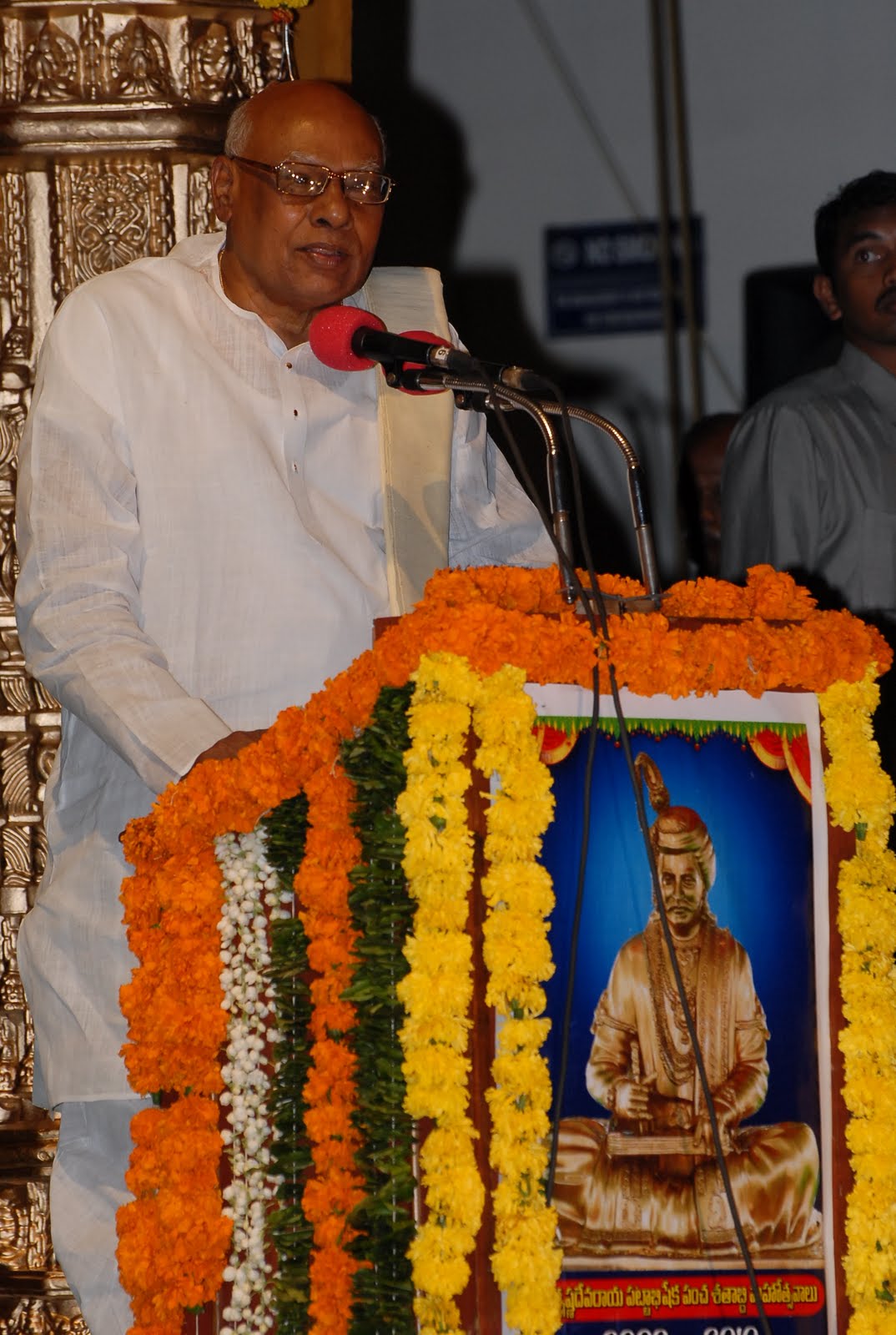
Desaraju Surya
Hyderabad: Konijeti Rosaiah had always been comfortable playing second-fiddle to any Congress Chief Minister in Andhra Pradesh over the years.
He, however, finds himself ill-at-ease being the Chief Minister as was evident in the last one year that he has been in the hot seat of power.
As he himself noted a few days ago, it had indeed been a “tight rope walk” for Rosaiah as Chief Minister, given the pulls and pressures from different quarters.
From a rather strong situation, the state has plunged into a vulnerable position in just one year because of various factors, beginning with the tragic death in a helicopter crash of a powerful Chief Minister.
The ruling Congress is in total mess; the strife over the demand for bifurcation of the state has only gone into a pause mode and threatens to snowball in the months to come; the state is still facing the economic recession blues and governance has become the biggest casualty leaving the people in the lurch.
Rosaiah himself is plagued by health problems, leading to doubts over his fitness to rule.
Rosaiah ascended the Chief Minister’s throne on September 3 last year following the death of Y S Rajasekhara Reddy in a helicopter crash on September 2.
It took more than three months for him to actually settle down in the new position and take control of the situation as the state moved from “one crisis to the other.”
By the time he could gain a grip on the administration, the Chief Minister was confronted with trouble from within his party in the form of a virtual rebellion from Kadapa MP Y S Jaganmohan Reddy, who set his eyes on the Chief Minister’s chair.
Though he left the Jagan issue to be handled by the Congress high command, Rosaiah could not breathe easy as he was not given the complete authority to rule, unlike his predecessor.
Everyone initially acknowledged that Rosaiah, given his vast political experience, was an “able administrator” though not an “able leader.” But now, given the sorry state of affairs, his credentials as an administrator too are at stake, political observers point out.
Bureaucrats say there has been a lack of “cohesiveness” in the administration in the last one year.
“Administration has become CM-centric when both N Chandrababu Naidu and Y S Rajasekhara Reddy were at the helm of affairs. Being powerful leaders, their writ ran large and the entire administration functioned according to their diktats. Bureaucrats used to look to the Chief Minister for everything previously as all instructions came from him directly. It’s not the case anymore,” a top-ranking IAS officer noted, explaining the “slackness” that is currently apparent in the functioning of the government.
The Chief Minister’s attempts to tone up the administration through a bureaucratic shake-up did not bear fruit for one reason or the other. “This has also left the bureaucracy in a state of despondency, leaving a telling impact on the administration,” a high-ranking IAS officer pointed out.
Rosaiah is famous for managing the state’s finances effectively given the fact that he presented not less than 16 Budgets over the years. As Chief Minister, who continues to hold the Finance portfolio, he is finding it an uphill task to continue the development and welfare agenda left behind by his predecessor.
All the major development projects have virtually come to a standstill as the government owes lot of money to the contractors.
Uncertainty prevails even over the welfare programmes as the subsidy bill has become too much to bear for the government.
Rosaiah, however, sought to “re-assure” everyone that not a single programme initiated by Rajasekhara Reddy would be abandoned. He is also unwilling to admit that governance has been paralysed in the state. “I am doing my best and touring the state. Even my ministers are doing their job,” he pointed out.
The general perception about his administration in the state is, however, entirely different from what the Chief Minister feels.
Hyderabad: Konijeti Rosaiah had always been comfortable playing second-fiddle to any Congress Chief Minister in Andhra Pradesh over the years.
He, however, finds himself ill-at-ease being the Chief Minister as was evident in the last one year that he has been in the hot seat of power.
As he himself noted a few days ago, it had indeed been a “tight rope walk” for Rosaiah as Chief Minister, given the pulls and pressures from different quarters.
From a rather strong situation, the state has plunged into a vulnerable position in just one year because of various factors, beginning with the tragic death in a helicopter crash of a powerful Chief Minister.
The ruling Congress is in total mess; the strife over the demand for bifurcation of the state has only gone into a pause mode and threatens to snowball in the months to come; the state is still facing the economic recession blues and governance has become the biggest casualty leaving the people in the lurch.
Rosaiah himself is plagued by health problems, leading to doubts over his fitness to rule.
Rosaiah ascended the Chief Minister’s throne on September 3 last year following the death of Y S Rajasekhara Reddy in a helicopter crash on September 2.
It took more than three months for him to actually settle down in the new position and take control of the situation as the state moved from “one crisis to the other.”
By the time he could gain a grip on the administration, the Chief Minister was confronted with trouble from within his party in the form of a virtual rebellion from Kadapa MP Y S Jaganmohan Reddy, who set his eyes on the Chief Minister’s chair.
Though he left the Jagan issue to be handled by the Congress high command, Rosaiah could not breathe easy as he was not given the complete authority to rule, unlike his predecessor.
Everyone initially acknowledged that Rosaiah, given his vast political experience, was an “able administrator” though not an “able leader.” But now, given the sorry state of affairs, his credentials as an administrator too are at stake, political observers point out.
Bureaucrats say there has been a lack of “cohesiveness” in the administration in the last one year.
“Administration has become CM-centric when both N Chandrababu Naidu and Y S Rajasekhara Reddy were at the helm of affairs. Being powerful leaders, their writ ran large and the entire administration functioned according to their diktats. Bureaucrats used to look to the Chief Minister for everything previously as all instructions came from him directly. It’s not the case anymore,” a top-ranking IAS officer noted, explaining the “slackness” that is currently apparent in the functioning of the government.
The Chief Minister’s attempts to tone up the administration through a bureaucratic shake-up did not bear fruit for one reason or the other. “This has also left the bureaucracy in a state of despondency, leaving a telling impact on the administration,” a high-ranking IAS officer pointed out.
Rosaiah is famous for managing the state’s finances effectively given the fact that he presented not less than 16 Budgets over the years. As Chief Minister, who continues to hold the Finance portfolio, he is finding it an uphill task to continue the development and welfare agenda left behind by his predecessor.
All the major development projects have virtually come to a standstill as the government owes lot of money to the contractors.
Uncertainty prevails even over the welfare programmes as the subsidy bill has become too much to bear for the government.
Rosaiah, however, sought to “re-assure” everyone that not a single programme initiated by Rajasekhara Reddy would be abandoned. He is also unwilling to admit that governance has been paralysed in the state. “I am doing my best and touring the state. Even my ministers are doing their job,” he pointed out.
The general perception about his administration in the state is, however, entirely different from what the Chief Minister feels.
Monday, 23 August 2010
THE GREATEST LEGAL PARADOX
THIS IS SAID TO BE THE GREATEST PARADOX IN RECORDED LEGAL HISTORY.
A few centuries ago, a Law teacher came across a student who was willing to learn, but was unable to pay the fees.
The student struck a deal saying, "I will pay your fee the day I win my first case in the court."
Teacher agreed and proceeded with the law course.
When the course was finished and the teacher started pestering the student to pay up the fee, the student reminded him of the deal and pushed days. Fed up with this, the teacher decided to sue the student in the court of law and both of them decided to argue for themselves.
The teacher put forward his argument saying: "If I win this case, as per the court of law, the student has to pay me as the case is about his non-payment of dues. And if I lose the case, the student will still pay me because he would have won his first case. So, either way I will have to get the money."
Equally brilliant, the student argued back saying: "If I win the case, as per the court of law, I don't have to pay anything to the teacher as the case is about my non-payment of dues. And if I lose the case, I don't have to pay him because I haven't won my first case yet. So either way, I am not going to pay the teacher anything".
This is one of the greatest paradoxes ever recorded in the Legal history.
(Reproduced from an email sent by my dear anna.)
A few centuries ago, a Law teacher came across a student who was willing to learn, but was unable to pay the fees.
The student struck a deal saying, "I will pay your fee the day I win my first case in the court."
Teacher agreed and proceeded with the law course.
When the course was finished and the teacher started pestering the student to pay up the fee, the student reminded him of the deal and pushed days. Fed up with this, the teacher decided to sue the student in the court of law and both of them decided to argue for themselves.
The teacher put forward his argument saying: "If I win this case, as per the court of law, the student has to pay me as the case is about his non-payment of dues. And if I lose the case, the student will still pay me because he would have won his first case. So, either way I will have to get the money."
Equally brilliant, the student argued back saying: "If I win the case, as per the court of law, I don't have to pay anything to the teacher as the case is about my non-payment of dues. And if I lose the case, I don't have to pay him because I haven't won my first case yet. So either way, I am not going to pay the teacher anything".
This is one of the greatest paradoxes ever recorded in the Legal history.
(Reproduced from an email sent by my dear anna.)
Subscribe to:
Posts (Atom)